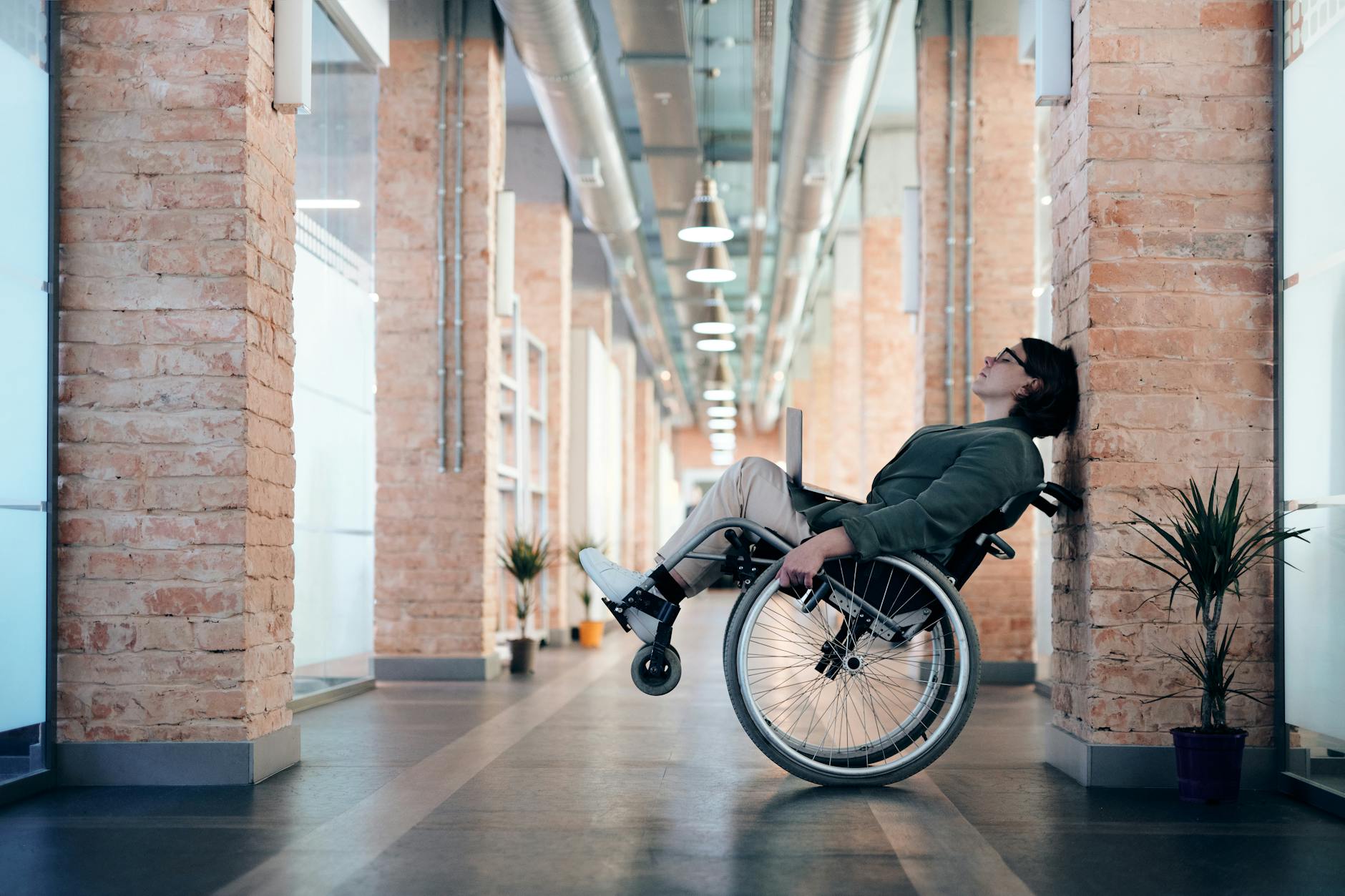
I was asked how I thought technology changes the way we think about disability and to share both a positive and negative example.
Technology has opened up new possibilities for what the future can look like. However, we are cautioned to consider our motivations for change and gain clarity around the kind of change desired by the communities actually served. As Shew (2020)1 warns us, “[t]he ableist attitude that disability is always a negative and always an individual problem extends into our ideas about and designs for the ideal future.” (p. 41)
A positive example of this is the invention of the power chair. I am unable to push a manual wheelchair and yet cannot walk far either, and so without my power chair, I would be wholly reliant on someone else’s assistance to get about. My chair is my freedom. Stevens (2019)2 writes of her own tech, “I feel a strong relationship with my assistive devices. They are freedom machines. When people touch them, I feel it.” (p. 5)
Shew also points out how “nondisabled people are often mistaken about what is bad about being a wheelchair user. Wheelchairs themselves are not the problem….The real problem with wheelchairs is accessibility, both environmental and economic.” (p. 46)
A negative aspect of my power chair’s technology is that, because it is so expensive, I am forced to use a mass-produced design that does not quite fit my body, leaving me to contend with aggravated chronic pain as a direct result of the design. Due to economic limitations, what should be opening my world, instead sometimes makes it smaller due to the aggravated physical pain it causes.
Technoablism and transmobility are ideas worth considering further. Nelson, Shew, and Stevens (2019) write:
“Transmobility is the idea that disabled bodies actually have a greater array of options for mobility and movement, providing an impetus for creativity and imagination. The idea of transmobility pushes us to consider embodied crip techniques as sites of liberation. We argue against the existence of any one appropriate mobility technology for a body—our bodies are spaces to think about possibilities. We are cyborgs—nay, cripborgs!—who need no one technology to move. Rather, our hybridized cripborged bodies can take shape and flight through various technologies. How our tools for mobility and body are chosen can vary and change significantly; we can be multimodal, and we need not create hierarchies in our technological choice.” (p. 2)
I love my cripborg body! Not only do I have my assistive devices, my body is also filled with metal implants that have saved my life and allowed me to become the person I am today. Whether I choose to use my power chair, walk with my cane, or even throw caution to the wind and walk unassisted, I am not “bound”3 by any of them.
As for technoablism, I encourage you to check out Shew’s blog post about it on her blog Technology and Disability. In the aforementioned article, Shew (2020) writes that technoablism is “a rhetoric of disability that at once talks about empowering disabled people through technologies while at the same time reinforcing ableist tropes about what body-minds are good to have and who counts as worthy.” (p. 43) In her blog post she continues by stating that
“[t]echnoableism suggests a very particular narrative about overcoming disability, how to do that and how other folks should engage in it. And, if you question it, the replies you get back doubt your experience and suggest that you actually agree. In other words, either you are wrong/deluded about your experience or you actually agree because – gasp – you do use technology. It suggests that using devices amounts to agreeing with narratives about technology as overcoming disability.”
I want to be clear that by saying my wheelchair represents freedom for me, I’m not saying that it allows me to “overcome” my disability. I’m still very much a disabled person, with all that entails, whether I’m in or out of my chair. Being in my chair doesn’t magically turn stairs into ramps, or stares into people minding their own business. My impairments still exist and I am still disabled by the default ableist world I live in.
- Shew, A. (2020). Ableism, Technoableism, and Future AI. IEEE Technology and Society Magazine, 39(1), 40–85. https://doi.org/10.1109/MTS.2020.2967492 ↩︎
- Nelson, M. K., Shew, A., Tech, V., & Stevens, B. (2019). Transmobility: Rethinking the Possibilities in Cyborg (Cripborg) Bodies. Catalyst: Feminism, Theory, Technoscience, 5(1), 1–20. ↩︎
- This brings up an excellent reminder: never say “wheelchair-bound”! We are not bound to our wheelchairs. We are freed by them! ↩︎
Leave a Reply