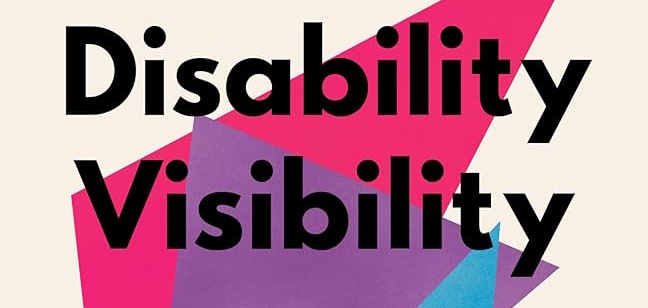
Liz Moore (they/them1) is a white, disabled, queer, nonbinary, and neurodivergent individual whose essay in the book Disability Visibility (2020) focuses on their long journey from active hopes and endless searches for a cure to acceptance of their impairments, most notably chronic pain. Moore begins their essay “I’m Tired of Chasing a Cure” by reflecting on what Robert McRuer (2006)2 has dubbed “compulsory able-bodiedness,” an assumption that, among other things, disabled people naturally want to be “normal”. In other words, not themselves. This is reflected throughout Moore’s essay in nondisabled people’s refrains of “have you tried…? have you tried…?” and Moore’s resulting self-blame and shame.
Paul Longmore (2003)3 writes, “Cure or correction has been viewed as the only possible means by which people with disabilities could achieve social acceptance and social assimilation. Those who are not cured or corrected have been defined as marginalized by disability. They have been relegated to invalidism. This has meant not just physical dependency or institutionalization but, most fundamentally, social invalidation.” (p. 217) If Moore were to stop endlessly looking for a cure, they would undoubtedly be seen as wrong for doing so because most nondisabled people cannot fathom how one can have a satisfying life while simultaneously experiencing ongoing physical or mental pain. Mitchel and Snyder (2015)4 refer to this as the “kill-or-cure” plot, but it extends here beyond media to be writ large upon a person’s lived reality.
When it comes to things like chronic illness and chronic pain, compulsory able-bodiedness can easily force disabled people into a perpetual loop of seeking to eradicate rather than accept. This leads to what Moore describes as being “battered by hoping.” Yet, when attempting to accept the reality of their life, Moore can be assumed by nondisabled people to be giving up instead of learning to accept and live. Susan Wendell describes a similar concept in her book, The Rejected Body (2013)5. She writes, “I feel the weight of a social obligation to be either healthy or miserable. Nevertheless, I have concluded that I am always sick and often happy, and that this seems very peculiar in my culture.” (p. 63) If we are in pain or ill, it is inconceivable that our lives might still hold joy, love, happiness, and purpose.
At the conclusion of their essay, Moore quite clearly answers Naomi Ortiz’s question in the Discussion Guide for Disability Visibility (2020): “What does the author hope will happen by accepting their chronic pain?” Moore writes, “The price is simply too high to live chasing cures, because in doing so, I’m missing living my life. I know only that in chasing to achieve the person I once was, I will miss the person I have become.” What Moore is saying here is that if we are constantly seeking to be something other than what we are, we will miss out on the life we have in front of us.
In addition to the entry in Disability Visibility (2020)6, Moore maintains a personal blog titled Liminal Nest, where they expand on this topic as well as many others. Their blog entries include a wide array of issues, including disability survival strategies, critiques of the medical system, and a special focus on the impairments and diagnoses with which they live, including Mast Cell Activation Syndrome (MCAS), neurological functioning, connective tissue disorders combined with chronic pain, as well as neurodivergence, gender, and sexuality. Kuppers and Wakefield (2009)7 describe disability culture, in part, “as a band that needs to create together rituals, codes, languages, art, and behaviors in order to strengthen their position.” (p. 269) On the same page, they go on to describe disability culture as “a strategy for survival.” This is absolutely what Moore is accomplishing with their blog. Moore’s writing becomes a way to share not just resources, but also a shared language and ideas about what it means to be disabled and live in an inaccessible world by default.
Moore is also a guest blogger on Rooted in Rights, a program of Disability Rights Washington, which “…uses accessible digital media to advance the dignity, equality, and self-determination of people with disabilities.” Moore’s two posts on the site include discussions about the dispensability of disabled folks during the pandemic and a discriminatory law against students with mental health concerns. Both concerns have been circulating within the disability community for quite some time and point toward the tendency toward a policy of eugenics for disabled folks during times of crisis and uncertainty.
On a personal note: In Buddhism, we have a concept of Right or Wise View. Essentially, in engaged Buddhism, especially, accepting reality does not mean doing nothing about it. To accept is not to become hopeless and give up. In fact, the opposite is true. To know reality is to understand how to respond to it. We cannot possibly know which actions to take (or not take) until we understand and accept Right View, the reality before us. I know from my personal experience of chronic pain that stopping endlessly seeking and accepting the fact that I am in daily chronic pain has allowed me to breathe more easily because I am not holding my breath, waiting for my cure. It has allowed me to release incessantly tensed muscles, bracing for the onslaught of self-blame for not doing the “right” thing to cure myself. It has allowed me to discover a depth of inner peace that I would not have otherwise found. It does not mean I have given up on a cure, or that I would not gladly accept one. What it does mean is that I come from a more centered place when considering my options and do my best to allow my decisions to come from an informed and balanced part of myself, rather than as a reaction to the ableism with which I am faced both externally and internally.
- NOTE: If you are to look up this specific Liz Moore online (there is more than one), you will find many people misgendering them and using she/her pronouns. Please don’t do that. ↩︎
- McRuer, R., & Bérubé, M. (2006). Crip theory: Cultural signs of queerness and disability. New York University Press. ↩︎
- Longmore, P. K. (2003). Why I burned my book and other essays on disability. Temple University Press. ↩︎
- Mitchell, D., & Snyder, S. (2015). Narrative. In Keywords for Disability Studies. NYU Press. ↩︎
- Wendell, S. (2013). The Rejected Body: Feminist Philosophical Reflections on Disability. Taylor and Francis. ↩︎
- Wong, A. (Ed.). (2020). Disability visibility: First-person stories from the twenty-first century (First Vintage Books edition). Vintage Books, a division of Penguin Random House LLC. ↩︎
- Kuppers, P., & Wakefield, M. (2009). Disability Culture. In Encyclopedia of American Disability History, Volumes 1-3 (1st ed). Facts On File, Incorporated. ↩︎
Leave a Reply